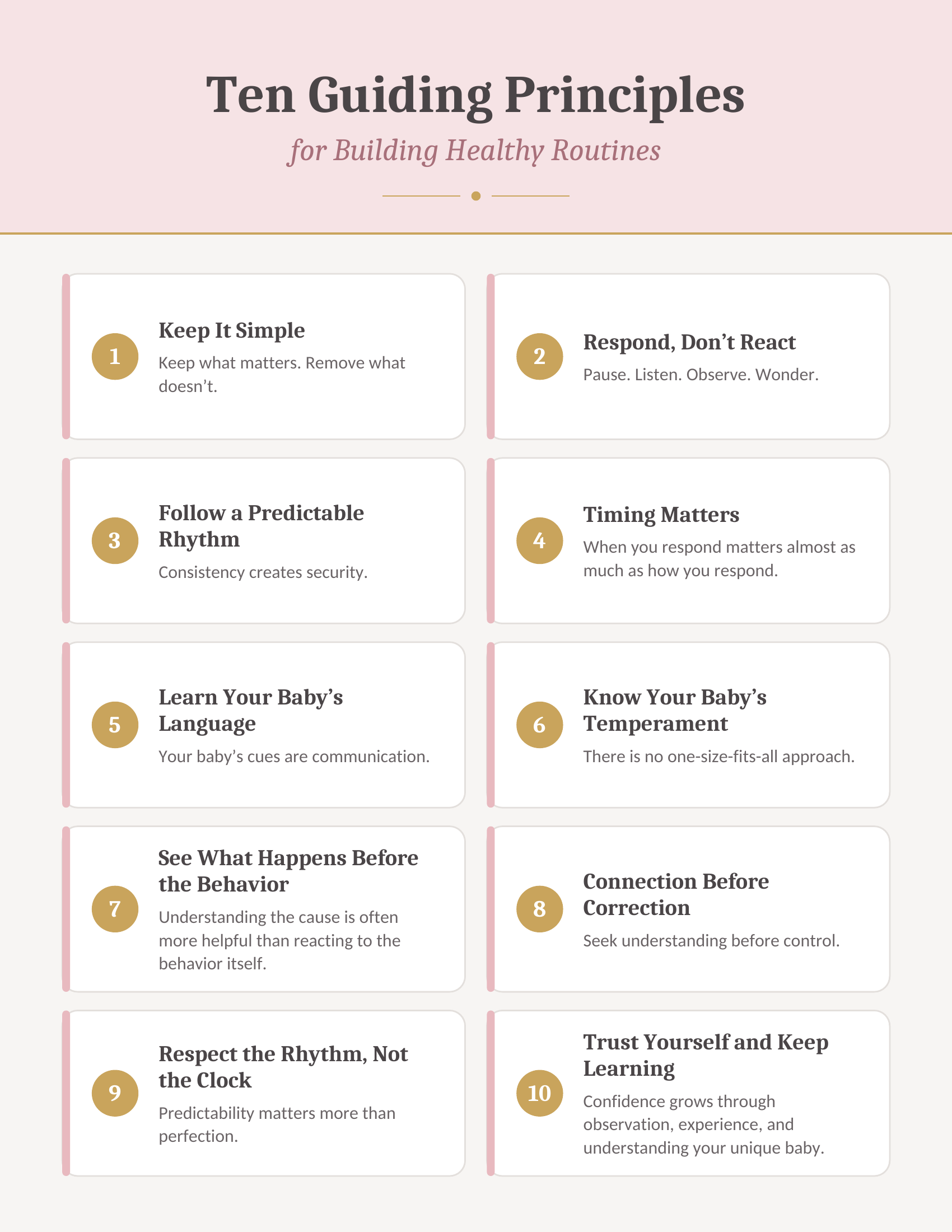


Why Routines Matter
From the moment babies enter the world, everything they have ever known changes.
In the womb, life was predictable. There was a steady temperature, constant movement, familiar sounds, and nourishment without effort. After birth, babies suddenly find themselves in a brand-new environment filled with new sights, sounds, sensations, people, and experiences.
Because so much is new, babies depend on us to help create a sense of order, predictability, and security.
Simple daily routines help babies understand their world and learn what comes next. When daily activities happen in a familiar pattern, babies begin to feel safe, confident, and secure.
Over time, routines become the framework that supports healthy social, emotional, and cognitive development.
Routines Benefit Parents Too
When we hear the word "routine," we often think about babies. The truth is that adults rely on routines too.
Most of us wake up at roughly the same time, brush our teeth, get dressed, drink coffee, eat meals, work, exercise, and go to bed in a familiar pattern. We don't usually think about these habits because they have become automatic.
But think about what happens when your routine is completely disrupted.
Maybe you've traveled across time zones, worked an overnight shift, stayed awake all night, or completely changed your schedule. Most people feel tired, overwhelmed, less productive, and out of sync.
Babies are no different.
Predictability helps us feel organized and secure. It does the same thing for babies.
Routine vs. Schedule
A routine is not the same thing as a strict schedule.
A schedule follows the clock.
A routine follows a predictable pattern.
The goal is not to feed, play, bathe, or put your baby down at exactly the same minute every day. The goal is helping your baby understand the natural flow of the day.
For example:
• Wake
• Eat
• Play
• Sleep
The exact times may change from day to day, but the order remains familiar.
Focus on the pattern, not the clock.
Predictability combined with flexibility creates routines that work in real life.
Eliminate the Guessing Game
One of the biggest benefits of a predictable routine is that it helps parents understand their baby's needs.
Without a routine, parents often feel like they're constantly guessing.
"Is my baby hungry?"
"Is my baby tired?"
"Does my baby want to play?"
"Is my baby overstimulated?"
When babies follow a predictable rhythm, many of these questions become easier to answer.
If your baby recently ate, enjoyed some awake time, and is now becoming fussy, there is a good chance they are becoming tired.
If your baby just woke from a nap and is showing feeding cues, hunger is likely the reason.
A routine does not eliminate every mystery, but it provides valuable clues and helps parents recognize patterns more quickly.
Over time, parents become more confident because they spend less time guessing and more time responding appropriately to their baby's needs.
Why Play Matters
Play is an important part of your baby's day.
Many people think newborns only eat and sleep, but even very young babies benefit from short periods of interaction and age-appropriate play.
Babies learn about their world through movement, observation, interaction, and exploration.
Play supports:
• Cognitive development
• Social development
• Motor skill development
• Language development
• Emotional growth
Play is your baby's work.
Remember that young babies have very short attention spans. Five to ten minutes of focused interaction can be extremely meaningful and developmentally appropriate.
Routines Build Security
Babies learn through repetition.
When the same activities happen in a familiar order, babies begin to anticipate what comes next.
This predictability helps:
• Build trust
• Support emotional development
• Encourage social engagement
• Reduce stress and frustration
• Create smoother transitions
• Increase confidence and independence
Over time, babies become more comfortable with their environment because they know what to expect.
Daily Activities Become Meaningful Cues
Everyday routines help babies understand what is coming next.
For example:
• A morning walk
• Tummy time after a diaper change
• Story time before bed
• Bath time before pajamas
• A bedtime song
• Turning on white noise before a nap
These activities become cues that signal transitions throughout the day.
Bath time doesn't make a baby sleepy, but when it consistently happens before bedtime, babies begin to recognize it as part of their bedtime routine.
Routines help babies predict their world.
And predictability creates security.
Eat–Play–Sleep Pattern
Many infant care professionals recommend an Eat–Play–Sleep pattern because it creates a natural flow to the day.
The pattern is simple:
• Baby wakes
• Baby eats
• Baby plays and interacts
• Baby sleeps
This rhythm gives babies an opportunity to be awake and engaged after feeding, participate in age-appropriate activities, and then transition naturally into sleep.
An Eat–Play–Sleep routine also helps prevent feeding from becoming the only way a baby knows how to fall asleep.
The goal is not perfection. The goal is creating a predictable flow that works for your family.
Understanding Feed-to-Sleep Associations
A feed-to-sleep association occurs when a baby relies on nursing or a bottle to fall asleep for naps or bedtime.
This is completely normal during the newborn stage. Newborns often become sleepy while feeding, and many babies naturally drift off at the breast or bottle.
As babies grow, however, feeding immediately before sleep can sometimes become a strong sleep association. In other words, babies learn to connect feeding with the process of falling asleep.
Babies naturally want to fall asleep the same way they fell asleep before.
For example:
• If a baby is fed to sleep at bedtime, they may look for a bottle or nursing session when they wake during the night.
• If a baby is rocked to sleep, they may expect to be rocked again when they wake.
• If a baby falls asleep independently, they are often better able to use that same skill when they wake between sleep cycles.
This is one of the reasons many infant care professionals recommend an Eat–Play–Sleep pattern as babies mature.
The goal is not to withhold feeds or create strict rules. The goal is simply to separate feeding and sleeping enough for babies to have the opportunity to learn additional ways to settle and transition to sleep.
Signs a Feed-to-Sleep Association May Be Developing
• Baby regularly falls asleep while feeding
• Baby struggles to fall asleep without a feeding
• Baby frequently wakes looking for another feeding shortly after falling asleep
• Parents feel feeding has become the only way to settle their baby
Remember, this is not a problem during the newborn period. Feeding to sleep is biologically normal and often necessary during the first weeks and months of life.
Around 4-6 months, many families begin gently separating feeding from sleep if feed-to-sleep associations are contributing to frequent night wakings or disrupted sleep.
Supporting a Healthy Routine
As babies grow and become developmentally ready, many families choose to:
• Feed at the beginning of the wake period
• Offer play, interaction, and age-appropriate stimulation
• Follow awake time with a nap
• Create predictable bedtime routines
• Place baby down sleepy but awake when appropriate
• Introduce consistent nap and bedtime cues
• Allow opportunities for independent settling
Consistency matters.
The first few days may be challenging when introducing any new routine. Babies learn through repetition, and predictable routines become easier when everyone follows the same approach.
A very tired or very hungry baby will often have more difficulty learning new patterns, so be mindful of your baby's developmental needs and individual temperament.
A Final Thought
The best routines are not the most rigid. They are the ones that fit your family's lifestyle while providing your baby with a sense of predictability, connection, and security.
When babies know what comes next, they spend less energy trying to understand their environment and more energy growing, learning, and thriving.
A predictable routine doesn't just benefit your baby. It helps the entire family feel more confident, organized, and connected throughout the day.
Remember: focus on the pattern, not the clock. Predictability and flexibility can coexist, and together they create a realistic routine that supports both babies and parents.